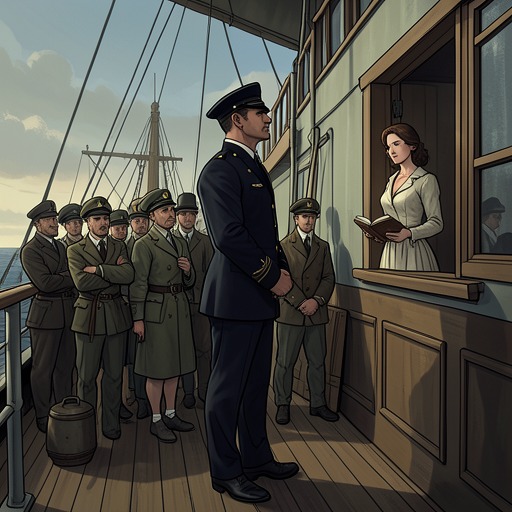
Sir David Pentland's will
Just DesertsSir David Pentland's will is not merely a testamentary list of possessions. It is the final instrument of Sir David Pentland's care: composed after the diagnosis of terminal stomach cancer, it protects Elizabeth Bennet, stabilizes Grenadine Reef, rewards those whose cooperation is necessary, and turns an improvised marriage into a legally defensible succession. Its force comes from the collision between bodily decline and administrative precision.## The Will's Urgent Background Sir David Pentland begins planning the will only after his mortality becomes immediate. He tells Elizabeth Bennet that the doctor believes he has cancer, that a growing lump in his stomach causes a constant ache with occasional spikes of pain, and that a diluted dose of laudanum helps him sleep. Lady Radha Pentland's earlier death has already made him more conscious of his age, but the cancer changes reflection into action. He had once intended to leave everything to his twin brother, James Pentland; after Lady Radha's death, and especially after Elizabeth's recent difficulties and her need to reach legal adulthood in order to escape Mrs. Bennet's control, he begins searching for a way to assist her. The diagnosis leaves no time for a gradual plan: what might once have been a long-term arrangement becomes a matter of weeks.
The will therefore belongs to a broader group of documents. Sir David asks James Pentland to witness the will, the marriage settlement, and the wedding, while also witnessing a letter in which Sir David's doctor and the local magistrate, Sir Frederick Wright, attest that he is of sound mind despite being physically ill. The purpose is explicit: Sir David is dying, but he wants the arrangement to be watertight. The medical evidence does not remove the seriousness of his condition; it establishes that the decisions are deliberate rather than the product of incapacity.## Drafting, Witnesses, and Legal Strategy James Pentland's agreement supplies the essential foundation. Sir David's brother and eventual heir could have refused the plan or challenged it on the ground that illness had impaired Sir David's judgment. Instead, James witnesses the new will and related instruments, receiving significant bequests for himself and his named children. The arrangement is ethically complicated because Sir David is plainly using money to secure consent, but it also reflects the practical vulnerability of a dying testator whose intentions could otherwise be defeated by inheritance law.
Sir David explains that James and his descendants are his only family and that he has made substantial bequests to them. The will is paired with a marriage settlement whose provisions are designed for the exceptional circumstances of Elizabeth's position. The usual provisions for a widow, unmarried children, and routine household arrangements are unnecessary or altered because Elizabeth is not a dependent widow entering an ordinary marriage. She is to become the central beneficiary and administrator of a large estate almost immediately, while James's cooperation must be secured before Sir David dies.
The drafting proceeds in a sudden acceleration. During the week after the proposal, arrangements that had first required prompt attention demand the utmost dispatch as Sir David visibly fades. The will and marriage settlement become nearly identical in their distribution. Apart from specific bequests to James Pentland and his named children, to Sir David's valet, and to other long-serving servants, almost everything is left to Elizabeth. The document thus recognizes several kinds of loyalty: family cooperation, personal service, and long-term labor on the estate.## Distribution and the Reading of the Will Sir David's marriage to Elizabeth occurs six days after his proposal, under a common licence, and the will is made effective within the same compressed sequence of events. The ceremony takes place while Sir David is already too weak to walk; he must be carried into the church in a chair. His condition gives the will an unusually visible context. This is not a distant administrative decision made by a healthy proprietor but the last act of a man who returns from the wedding breakfast to his room and never leaves it alive.
After Sir David dies, the reading of the will places Elizabeth under the weight of the estate he has transferred to her. James Pentland receives seventy-five thousand pounds, a sum large enough to make Elizabeth fear that little ready money may remain. Once she learns the extent of the funds still available, however, the scale of Grenadine Reef finally becomes clear, and the suppressed strain of the previous days breaks through. She cries for more than an hour before Madeline Gardiner can calm her. The inheritance is therefore not represented as uncomplicated triumph. It is an immense responsibility arriving simultaneously with widowhood, bereavement, and the loss of the man who arranged it.
The document also makes a sharp contrast with the management of Longbourn. Thomas Bennet treats his estate as secondary to books and academic interests, doing what is necessary but no more, while Elizabeth has been quietly carrying out work whose importance becomes apparent only after she leaves. Longbourn consequently produces less than it should, even though Jane Bennet and Mary Bennet labor to maintain it. At Grenadine Reef, by contrast, the new settlement gives Elizabeth the resources and authority to continue a form of active stewardship that had previously been hidden behind other people's legal titles.## Elizabeth's Control and the Marriage Settlement The will cannot be separated from the settlement of Grenadine Reef after Sir David's death. Fitzwilliam Darcy points out that when a man marries a woman, he normally gains control of the assets she brings to the marriage. Because Elizabeth is an exceptional bride, the marriage settlement expressly provides that anything connected with Grenadine Reef and the smaller estates can change only with her explicit written permission. During their lifetimes, she is to be the real mistress of the estate regardless of the formal legal position.
This provision limits the ordinary transfer of power that marriage would impose on a woman. Sir David's will gives Elizabeth the property; the settlement protects her control of it once she becomes married to Fitzwilliam Darcy. The legal architecture therefore divides ownership, control, and management rather than assuming that marriage should collapse them into a husband's authority. Sir David's testamentary intention survives him not only through Elizabeth's inheritance but through a contractual safeguard against the loss of her practical independence.
The arrangement also explains why Fitzwilliam Darcy's later involvement with Netherfield Park does not amount to the same kind of passive proprietorship found at Longbourn. He acquires the remainder of the lease through solicitors while keeping his name out of the transaction so that he can bargain effectively with Charles Bingley. He then intends to spend at least half of each day managing Netherfield Park, improving its spring plantings, and dealing with estate correspondence. The contrast reinforces the will's governing principle: property is sustained by attention, knowledge, and accountable management, not by title alone.## Legacy and Narrative Significance Sir David Pentland's will is the material form of his final ethical judgment. Throughout his life he has acted as a protector of vulnerable women: he rescued Radha Bhimani from slavery after she was taken from Kutch, cared for her after she was wounded and left behind by the surviving religious order, and later supports women leaving the Grenadine Reef refuge by ensuring that they travel in groups so that no woman must journey alone. His generosity is therefore not an isolated sentiment attached to Elizabeth's inheritance. It is consistent with a pattern of converting wealth into safety.
The will also completes the relationship between Sir David and Elizabeth. He recognizes that Elizabeth's life has been constrained by her family and that her intelligence has been undervalued, just as Lady Radha Pentland's business judgment was openly acknowledged by Sir David despite the prevailing assumption that men were superior in commerce. In transferring the estate and protecting Elizabeth's authority, he gives legal form to a different model of partnership: Elizabeth is not purchased as a dependent bride, and she is not merely installed as a symbolic widow. She becomes responsible for people, land, servants, tenants, and future decisions.
Its consequences extend beyond the moment of probate. Grenadine Reef continues to run smoothly, while Longbourn's decline becomes more visible after Elizabeth's departure. The will thus exposes the hidden labor behind a functioning estate and makes inheritance a question of governance rather than possession. Sir David's death removes him from the narrative, but the document keeps his judgment active in the world: it protects Elizabeth's independence, gives her the means to act, and ensures that his final act of care remains legally and socially consequential.